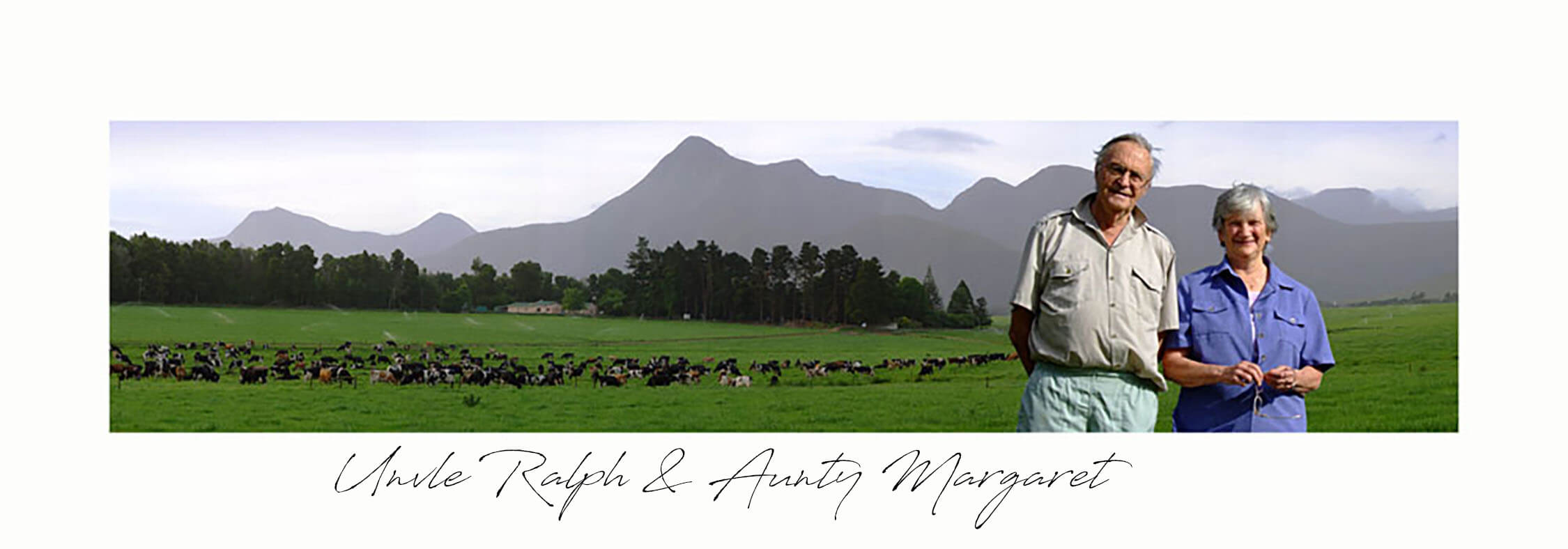
Lot #7 (Grasslands)
Purchase of Lot #7 in Tsitsikamma

The history of Grasslands, in the words of Ralph and Margaret Elliott:
In September 1967, we signed the deed of sale for a piece of land in the Tsitsikamma, called Lot No7. We don’t know who the original owner of Lot No 7 was, but we do know that he worked in the forest and that he used to run his cattle there.
We were also told that he ran up debt at a store in Humansdorp owned by a Mr Rademeyer. One day he couldn’t settle his debt, so he shrugged his shoulders and said to Mr Rademeyer: “Ag, vat maar die grond!”
This plot, known as “die Rademeyer grond”, was never used by Rademeyer and it soon reverted back to bush. When Mr Rademeyer died his two daughters put it up for sale.
In the early 1950’s, Ralph read the book “Grasslands of New Zealand” by Sir Bruce Levy which inspired his dream to farm low-cost New Zealand style pastures. We decided to call our new farm “Grasslands”, after the experimental farm where Sir Bruce Levy had done his research and written the book.
We started off living in our caravan on the Manning’s farm, Gradita. They were wonderfully good to us and helped us in so many ways. The first job to be done was to have the property cleared and burnt.
Many people considered it a stupid idea for us to go farming in the Tsitsikamma. Ralph came from an area of the Eastern Cape where stock farming on veldt was the only kind of farming people knew. Nobody believed that one could make a living from such a small area as the 168 ha that made up Grasslands.
Grasslands was sometimes referred to as a ‘plot’, not a farm. Once an area had been cleared on Grasslands we moved our caravan onto the farm, to live there for the first time. During this early period, we realized how very raw this new farm was. There was nothing on it but bush and burnt logs and sticks and a broken-down sod house.
What we missed the most in those early days was water on tap. There were paraffin lamps and fridges, so electricity was not of vital importance but to fetch water from a hole in the stream down in the vlei was a real trial. We had no bath or toilet but the Mannings often invited us over for a meal and a bath and on hot summer days we used to take soap and towels and go down to the Storms River at the bottom of the old pass to wash. Our toilet was a deep hole in a pretty part of the forest with a wooden box on top and a large coffee tin as a toilet roll holder!
It was about this time, in 1971, that we got cold feet. The task appeared so daunting and there were so many people intimating that we were making a mistake that we decided to quit. We put Grasslands on the market, advertising it in “The Farmers Weekly”, “Die Weekblad” and the “Natal Witness”.
Two people showed an interest in the property, but neither were prepared to pay the asking price of R300 – 00 per morgen, so we just had to “vasbyt” and get on with the job. We erected a prefabricated asbestos shed and moved the caravan into the shed, put up the tent to screen a bath and had a drainpipe coming through the asbestos wall where hot water could be poured into the bath from a drum on bricks over a fire outside.
Our original intention in buying Grasslands was to run sheep on pasture for fat lamb production. However, Ralph was subscribing to the “New Zealand Farmer” and the New Zealand “Agricultural Journal” and reading these it soon became apparent that dairying would be most profitable for “Grasslands”. The New Zealand concept of running dairy cows on an all-grass system combined with seasonal calving and the use of herringbone sheds made dairying look a lot less like slavery.
It was also easy to work out the likely cost structure because the New Zealanders always quoted production in terms of butterfat production per acre. Since one knew that they didn’t feed any concentrates and that they used very little machinery on an all-grass system, it was quite easy to work out the expectations of profit from dairying.
Also, at that time, the Rand was much stronger than the New Zealand dollar so in terms of cents per litre the South African farmers were receiving three or four times as much for their product in those days than the New Zealanders were. With these facts in mind, it would have been foolish not to go the dairy route.
At that stage too the Queenstown Dairy Co-Op were planning to set up a cheese factory in Humansdorp but that never happened, and we had to wait six years before Nestle started collecting milk in the area. This made life very hard at the start.
During this period, while there was no market for milk, local people told Ralph that he must grow a crop of potatoes prior to planting pastures, in order to ‘tame’ the soil!
So, we tried potatoes for a couple of years but unfortunately struck a glut in the market.
We also tried growing youngberries and gooseberries. This was labour intensive with very little profit.
It must have been early in 1974 that Nestle started taking an interest in collecting milk in this area. They sent some of their field staff to assess the area from a dairy point of view and not surprisingly, they found that very little cream was coming from the Tsitsikamma. Not much farming was being done here and very few farmers were interested in producing cream. However, those few of us who were interested in dairy, did our best to convince them that there was considerable potential for dairy in this area. Ralph, as secretary of the Witelsbos Farmers Association, wrote to Nestle suggesting that if they put a truck on the road to pick up cans, the milk supply would soon pick up.
In August 1974, Nestle picked up the first load of only 12 cans in the whole area. Several of the cans were only half full or less. From that day onwards the supply of milk from this area has never stopped increasing.
Nestle and in particular their extension officer Hennie Kellerman, did a great deal to encourage the production of milk from the Tsitsikamma. In the early days when milk was sent in cans all the milk arrived there sour. This was inevitable seeing that no farmers had cooling facilities. But Nestle paid for this sour milk even though they didn’t use it. Nestle also encouraged the farmers by organising lectures and field days to give technical assistance to train the farmers and to build up this area.
So you see, life goes on and there have been many changes in the Tsitsikamma since then. The biggest change has been infrastructure. There was none when we got here. It was considered a dead-end area. Old Josie van Wyk, who was barman at the Forest Inn at the time, used to describe the Tsitsikamma as “the back end of the world”.
We tried to borrow R10 000-00 from the Land bank and after an evaluation of the property the report to the bank stated that Grasslands was an “uneconomical unit”, and the application to raise a bond was turned down.
The Tsitsikamma was considered useless and was the last area in South Africa to be pioneered for farming. But aren’t we lucky to live here now.
In 1990, Trevor and Sue moved to Grasslands and took over the management of the fa rm. At that point Ralph and Margaret had grown the herd of milking cows to 208 and were still supplying Nestle.
Having worked in the packaging industry, Trevor had gained experience in marginal costing. Applying this experience to Grasslands’ study group figures and correctly allocating marginal and fixed costs, he realised the untapped potential for dairy farming in South Africa by increasing stock numbers.
Grasslands Agriculture (Pty) Ltd was registered in 2001.